
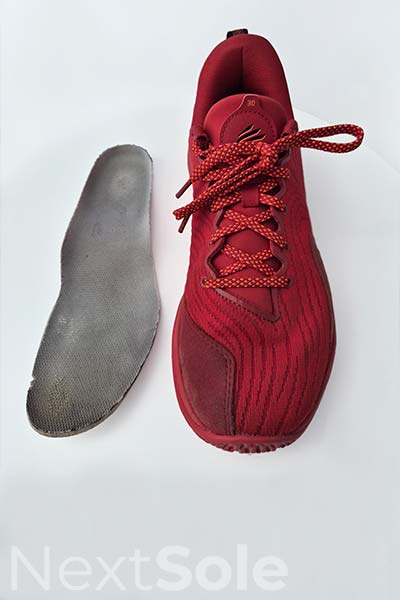
You spend $180 on a decent pair of runners. Three months later, the insoles are pancake-flat, and your kid is complaining about sore legs after training. You assume it’s growing pains. It’s not. It’s foam failure — and it’s built into almost every sub-$200 shoe on the market.
The Material Problem
The insoles in most mid-range runners are made from open-cell EVA (ethylene-vinyl acetate) foam. It’s cheap, light, and easy to mould. It’s also fundamentally unsuited to repetitive high-impact activity.
Open-cell foam works by compressing under load and slowly expanding back to shape. Under light, infrequent use — walking to the car, casual wear — it recovers adequately. Under the load of an active kid running, jumping, and changing direction across a full day or training session, it doesn’t. The cells compress faster than they recover. Over weeks of daily use, the cells collapse permanently. The foam stays flat.
At that point, the insole is doing nothing except filling space inside the shoe.
Why Kids Accelerate the Failure
An adult walking 8,000 steps a day compresses their insoles at a much slower rate. A kid in active sport is a different load entirely.
Running generates ground reaction forces of two to three times body weight per step. A 35kg child sprinting produces over 100kg of force through each foot strike. Multiply that by thousands of steps per day, across five days a week, and the compression load on an EVA foam insole is enormous.
Add heat and moisture — both of which are constant inside a shoe during exercise — and the degradation accelerates further. Foam breaks down faster in warm, wet environments. A kid’s shoe during sport is both. The foam never fully dries between sessions, the cell structure weakens, and cushioning life shortens significantly.
Most manufacturers rate their insoles for casual adult wear. They are not engineered for the specific demands of active kids.
The Layering Gap
High-performance insoles use layered construction for a reason. Each layer handles a specific mechanical job:
A gel or TPU base layer handles energy return. When compressed, it pushes back — returning force to the foot rather than absorbing it and staying compressed. This is the rebound mechanism that cheap foam lacks entirely.
A memory foam mid layer handles contouring and comfort. It conforms to the individual shape of the foot, distributing pressure evenly and reducing localised loading on the heel and ball.
A breathable top fabric manages moisture. Sweat pooling at the foot-insole interface accelerates foam degradation and creates the conditions for bacterial growth and odour.
When a single-layer EVA foam insole tries to do all three jobs simultaneously, it fails at all three faster than a layered insole fails at any one.
What Flat Insoles Actually Cost
A flat insole isn’t just an uncomfortable insole. In a growing foot, it’s an absent support structure.
Kids with flat feet or over-pronation rely on insole geometry to maintain correct foot alignment during movement. When the arch support collapses — which happens to foam insoles well before they look visibly worn — the foot rolls inward through every stride. Over a full season, that’s millions of repetitions of incorrect loading through the ankle, knee, and hip.
The runners still look fine. The insole has been dead for months.
The Fix
Replacing the stock insole in your kid’s runners with a purpose-built active insole isn’t an upgrade — it’s correcting a design gap that the manufacturer left in place to hit a price point.
The stock insole in a $180 runner costs the manufacturer under $3 to produce. It is not engineered for active kids. It is engineered to feel adequate in the shop and for long enough after purchase that the connection between insole failure and foot fatigue isn’t made.
A purpose-built insole with gel rebound, memory foam cushioning, structured arch support, and a breathable top layer addresses each failure point directly. It costs less than the shoe it goes into and outlasts the stock insole by a significant margin under the same conditions.